Loading...
Serving Anchorage, AK and surrounding areas. (907) 202-5481
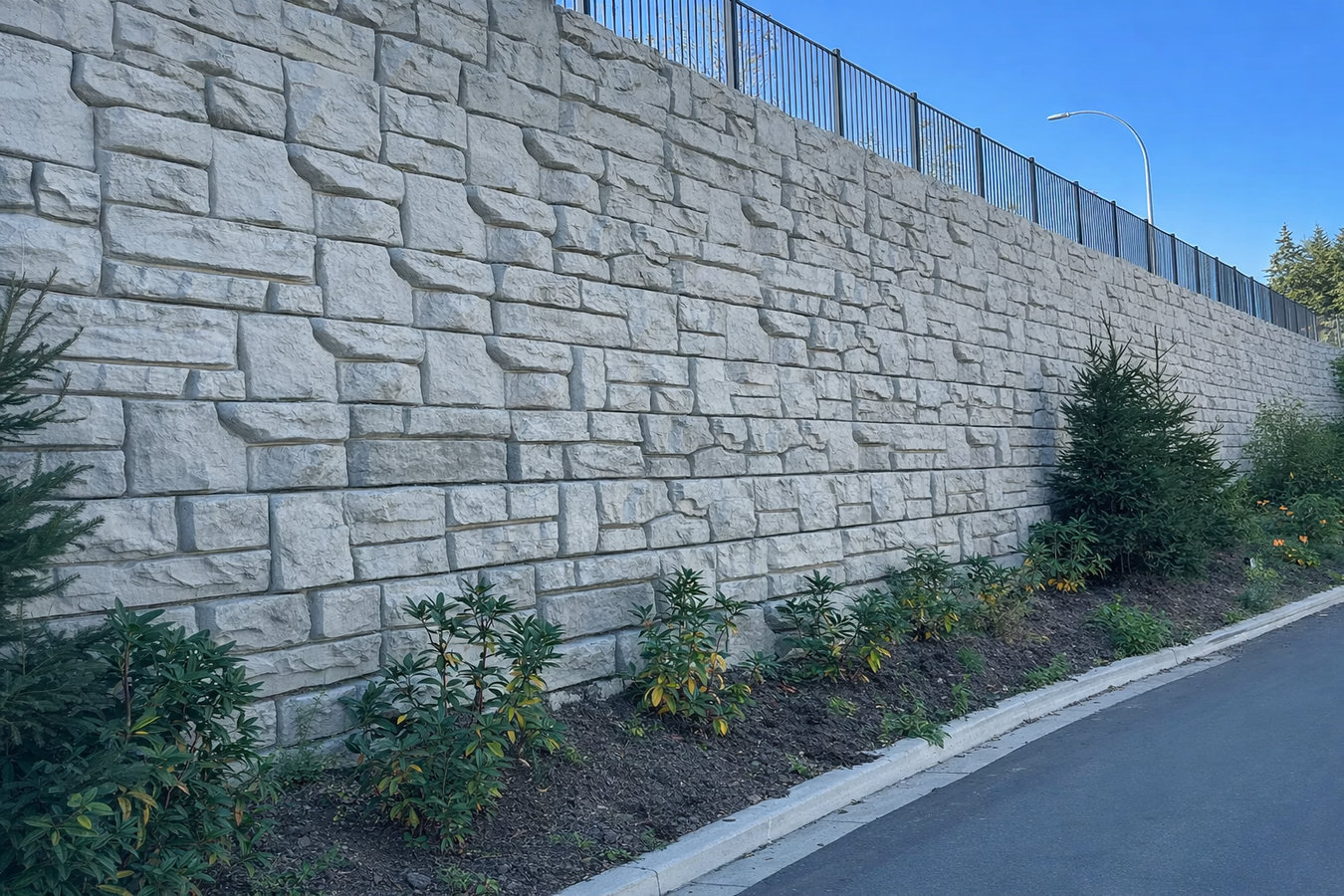
Sliding soil, crumbling grades, and water pooling near your foundation are not problems that fix themselves. We build concrete retaining walls designed for Anchorage winters, frost depth, and spring snowmelt.
Concrete retaining walls in Anchorage hold back soil that would otherwise slide, slump, or wash away - especially on sloped yards and hillside properties - with most residential projects completed in three to five days of active construction once permits are in hand.
If your yard slopes toward your home or you have watched topsoil wash downhill every April, you already know the problem. A concrete retaining wall is the permanent fix that stops that movement at the source. Many Anchorage homeowners also look at concrete footings alongside their wall project, since both depend on proper frost-depth engineering to perform in Alaska winters.
Unlike timber or a block retaining wall, a concrete wall is poured as a single monolithic structure - there are no joints for frost to work into, no blocks to shift, and no posts to rot. In a climate like Anchorage's, that durability difference becomes obvious after the first decade.
If you notice soil creeping toward the low side of your property each April or May, the slope is not stable. In Anchorage, saturated thawing ground accelerates this movement quickly. A retaining wall stops it before it reaches your foundation, driveway, or neighboring lot.
When soil shifts, it often shows first as cracks in concrete flatwork, gaps between your driveway and the ground, or separation between your foundation and surrounding soil. These are signs the earth is moving in ways it should not. Catching this early makes the repair far less expensive.
Water consistently collecting near your foundation after rain or thaw often means the grade is pushing moisture toward your home. A retaining wall combined with proper regrading can redirect that water and protect your foundation from long-term damage.
If an existing wall is starting to lean away from the slope, crack horizontally, or show gaps where sections meet, it is under more pressure than it can handle. Anchorage freeze-thaw cycles make these problems worse each winter rather than allowing them to stabilize.
We build cast-in-place concrete retaining walls for residential and light commercial properties across the Anchorage area. Every wall starts with a site visit so we can assess your slope, soil conditions, and drainage needs before recommending a design. For homeowners dealing with severe slope movement, we often pair wall work with concrete floor installation when the yard project connects to a garage or basement space that also needs attention.
All of our walls include engineered frost-depth footings, gravel backfill, and perforated drain pipe. These are not optional upgrades - they are how walls survive Anchorage winters without cracking, heaving, or leaning. If you are comparing quotes, ask every contractor whether drainage and frost-depth footings are included, because skipping them is the most common reason walls fail early.
Suited for shorter walls where the mass of concrete alone holds back the slope - a straightforward, durable solution for most residential grades.
The right choice for taller walls and sites with heavier soil loads, using an engineered footing to distribute pressure safely into the ground.
Ideal for steep hillside lots where a single wall would be too tall - multiple shorter walls create usable flat terraces on your property.
Every wall we build includes proper gravel backfill and drain pipes - critical in Anchorage where spring snowmelt creates intense pressure behind any wall.
A significant portion of Anchorage residential neighborhoods - particularly the Hillside, South Addition, and upper Turnagain areas - sit on sloped terrain where retaining walls are essential for usable yard space and slope stability. The Municipality of Anchorage has specific development standards for hillside properties, and walls on steeper lots often require engineered drawings regardless of height. That is not a bureaucratic inconvenience - it is the city recognizing that Anchorage slopes carry real risk without proper engineering. Beyond the obvious hillside concerns, Anchorage's ground freezes to 42 to 48 inches each winter, and that freeze-thaw cycle puts enormous lateral pressure on any wall that is not built with it in mind. A wall that works fine in a milder climate can crack, tilt, or heave completely out of the ground here if the footing depth and drainage are not designed for local conditions.
We work all across the greater Anchorage area, including Wasilla and Palmer, where sloped properties and spring runoff create similar drainage and stabilization challenges. If your property is outside Anchorage proper, call us - we can confirm whether your address falls within our service area.
We ask a few basic questions about your slope, wall height, and any drainage issues, then schedule a site visit before giving you a firm quote. Expect the visit to take 30 to 60 minutes - use it to ask everything on your mind.
If your wall exceeds four feet or sits on a hillside lot, we pull the Municipality of Anchorage building permit before any work begins. Permit approval typically takes one to three weeks - we keep you updated and handle all the paperwork.
The crew excavates below the frost line - in Anchorage, that means going 42 to 48 inches deep - and compacts a stable gravel base for the footing. Clear the work area of anything you do not want disturbed before the crew arrives.
We set forms, pour the concrete, install gravel backfill and drain pipes, then compact the soil behind the wall in layers. After curing, we do a final walkthrough with you to confirm everything looks right and answer any questions.
Free on-site estimate. No obligation. We reply within one business day.
(907) 202-5481Anchorage frost lines run 42 to 48 inches deep, and a wall with shallow footings will heave within a few winters. We engineer every footing to go below local frost depth - it is non-negotiable here and sets the foundation for a wall that holds its position for decades.
We handle the Municipality of Anchorage permit application from start to finish, including coordinating inspection sign-off. You get a fully documented, legally compliant wall - which matters a great deal when you go to sell your home.
Poor drainage is the leading cause of retaining wall failure. We install perforated drain pipe and gravel backfill behind every wall so spring snowmelt escapes rather than pushes. The American Concrete Institute recommends this as a core requirement - we treat it as one.
Anchorage sits in one of the most seismically active regions in the country, and hillside development standards here are specific and enforced. We know which neighborhoods warrant extra engineering attention and will tell you plainly what your site requires before you commit to anything.
The details that matter most on a retaining wall - footing depth, drainage, and permitting - are exactly where we focus. You can verify any contractor's Alaska license through the State of Alaska license lookup, and we encourage you to do that with every contractor you call. The best crews in Anchorage welcome that kind of scrutiny because they know they hold up to it.
New concrete floors for basements, garages, and utility spaces - poured to handle Anchorage's freeze-thaw cycles and unstable soil conditions.
Learn MoreEngineered footings dug below Alaska frost depth to anchor structures against frost heave and seasonal ground movement.
Learn MoreAnchorage's concrete season runs roughly May through September - the best crews book out fast in spring. Call now or request an estimate online to lock in your project date.